MOTS-c in blood, muscle and an energy shortage
A circulating peptide can help describe illness. Giving that peptide to a body is another experiment, and the muscle papers take place mostly in mice.
The patients received dialysis
The human cohort followed 94 patients on chronic haemodialysis for a median of 26.5 months. Researchers measured circulating MOTS-c and tracked a combined outcome of death from any cause or non-fatal cardiovascular events. MOTS-c was independently associated with that outcome.
Adding the peptide measurement improved the reported risk-model discrimination: ROC AUC rose from 0.727 to 0.743. That is a finding about prediction in this cohort. There was no experimental MOTS-c treatment group.
I had been expecting the human paper to bring the treatment story closer. Instead it supplied a useful reason to separate the peptide already present in somebody’s blood from a peptide given to change their health. The study leaves the latter question open.
MOTS-c exercise experiments
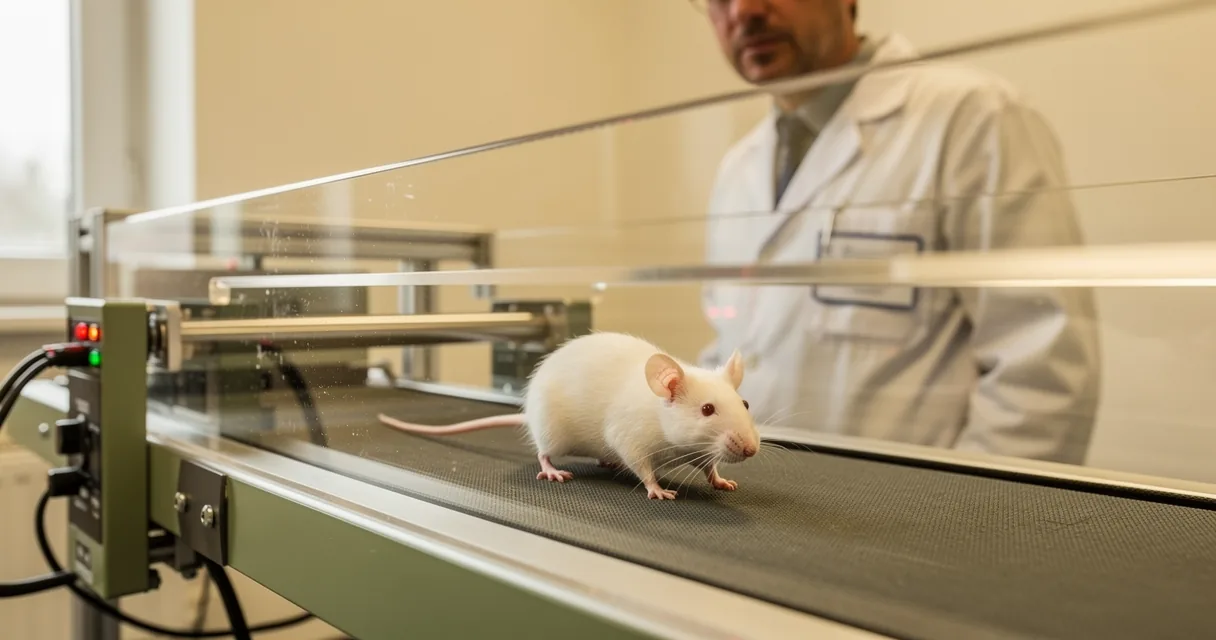
In the exercise and ageing experiments, added MOTS-c improved physical performance in young, middle-aged and old mice. The researchers assessed treadmill running, grip strength and gait; the treadmill improvement was particularly clear in old mice. Exercise also induced the animals’ own MOTS-c.
This is a treatment experiment, with movement as an outcome. It is also mouse work. The phrase exercise mimetic describes an experimental ambition to reproduce some effects of exercise, while a human benefit from added MOTS-c still awaits a treatment trial.
I’d concentrate on mouse movement before entertaining an unspecified promise of longevity. Movement gives the claim a defined task. It still leaves human strength, endurance and long-term safety to be tested.
An energy sensor and a direct binding target
MOTS-c contains 16 amino acids and is encoded within mitochondrial DNA. Mitochondria are the cell structures involved in energy production. The review of stress, metabolism and ageing describes inhibition of the folate cycle and purine synthesis, leading to activation of AMPK, a protein that helps cells respond to their energy supply.
In human and mouse cell experiments under metabolic stress, MOTS-c moved to the nucleus and altered gene expression involved in metabolic and antioxidant responses. Here stress meant conditions such as an energy shortage in cells, rather than a person’s emotional state.
The CK2 study adds a more specific connection. Cell-free assays identified direct binding and activation of CK2, a protein involved in cellular signalling. Mouse experiments linked tissue-specific CK2 effects to greater muscle glucose uptake and resistance to muscle loss. The direct binding was measured in laboratory assays; the muscle outcomes were measured in mice.
Human safety and the exercise claim
The treatment evidence summarised in the MOTS-c review remains preclinical. There is no validated human half-life, dose-response or established formulation for treatment. Endogenous production supplies a biological starting point; it cannot settle the consequences of adding more.
The research also describes inherited sequence differences and variation in exercise responses. Some findings rely on small samples or await wider replication. A single story about metabolism would smooth away those complications.
MOTS-c lacks FDA approval. Its research-grade identity, purity and sterility cannot be assumed, and sports bodies prohibit it under their performance-drug rules. Claims of fat loss, endurance or longer life have run ahead of the human treatment evidence. MOTS-c’s muscle biology excites me; those broad claims remain unearned. The questions page covers the safety and timing questions for which this record still lacks a dependable answer.